
What Are Custom Orthotics and Do You Actually Need Them?
Custom orthotics are prescribed foot insoles designed to correct your specific biomechanics. But not everyone needs them. Here's how to know if they'll help you.
TL;DR
Custom orthotics are prescription insoles fabricated specifically for your foot based on a clinical biomechanical assessment. They're not the same as pharmacy insoles. They're not needed by everyone, but for specific conditions they're one of the most effective long-term treatments available. The only way to know if they'll help you is a proper assessment.
Orthotics get a mixed reputation. Some people wear them for years with complete relief. Others try them and find them uncomfortable, unhelpful or not worth the cost. The difference is almost always whether they were properly prescribed for a real clinical indication, or purchased off a shelf without a proper assessment.
This article explains what custom orthotics actually are, how they differ from generic insoles, which conditions they're supported by evidence, and how to know whether you actually need them.
What Are Custom Orthotics?
A custom orthotic (also called a foot orthosis or custom foot insert) is a prescription insole fabricated specifically for your foot based on a clinical assessment of your gait, foot posture and lower limb biomechanics. They sit inside your shoe and modify the way your foot and lower limb move through the gait cycle - altering where load is concentrated, how much the foot pronates or supinates, and the mechanical demand placed on specific structures.
They are fundamentally different from the gel or foam insoles available at pharmacies and sports stores. Those are generic products designed around an average foot shape. A custom orthotic is prescribed and fabricated to address your specific biomechanical profile and the specific structural or functional problem driving your symptoms.
What Conditions Do Custom Orthotics Help With?
The conditions where custom foot orthotics have the strongest evidence base include:
- Plantar fasciitis and heel pain: Orthotics that offload the plantar fascia insertion and control calcaneal eversion are well-supported by randomised controlled trials for both short and long-term outcomes.
- Achilles tendinopathy: Heel raises and semi-rigid orthoses that reduce the stretch load on the Achilles during the stance phase of gait.
- Patellofemoral pain (runner's knee): A British Journal of Sports Medicine systematic review found foot orthoses reduced patellofemoral pain, particularly in runners with pronated foot posture.
- Tibial stress syndrome (shin splints): Shock-absorbing orthotics with medial arch support reduce the tibial bending moment that contributes to periosteal irritation.
- Metatarsalgia (ball of foot pain): Metatarsal padding or offloading orthoses reduce focal pressure under the metatarsal heads.
- Hallux valgus (bunions): Orthotics don't reverse bunion deformity, but they can slow progression and reduce the load that aggravates the joint.
- Diabetic foot offloading: Total contact insoles and offloading orthotics are a core component of ulcer prevention and wound management in high-risk diabetic feet.
- Flat feet (pes planus): For symptomatic flat feet causing arch fatigue, heel pain or downstream knee and hip pain. See our detailed post on orthotics for flat feet.
Custom vs Off-the-Shelf: How Do You Know Which You Need?
The decision is clinical, not just about preference or cost. Off-the-shelf orthotics are appropriate as a first-line trial for mild presentations or when the clinical picture suggests the condition will respond to general arch support and cushioning. They're significantly cheaper and widely available.
Custom orthotics are warranted when:
- The condition hasn't responded to a genuine trial of off-the-shelf products
- The foot has a structural characteristic (high arch, severe flat foot, leg length discrepancy) that a generic product can't adequately address
- The condition is recurrent or complex, with multiple contributing biomechanical factors
- High physical demands (athletes, people with physically demanding occupations) require greater precision in load management
- The patient has diabetes or neuropathy, where precise offloading of specific pressure areas is clinically important
What Does the Custom Orthotic Process Involve?
The process at Bexley Podiatry starts with a full biomechanical assessment. This includes observation of your posture and gait, measurement of your foot posture index, assessment of ankle and subtalar joint range of motion, and identification of the structural and functional factors contributing to your symptoms.
Your foot shape is then captured for casting. The three main methods are:
- Foam box impression: The foot is pressed into a foam block in a semi-weight-bearing position, capturing the plantar shape.
- Plaster casting: A plaster bandage is applied to capture the foot in a precisely controlled neutral position. Considered the gold standard for complex prescriptions.
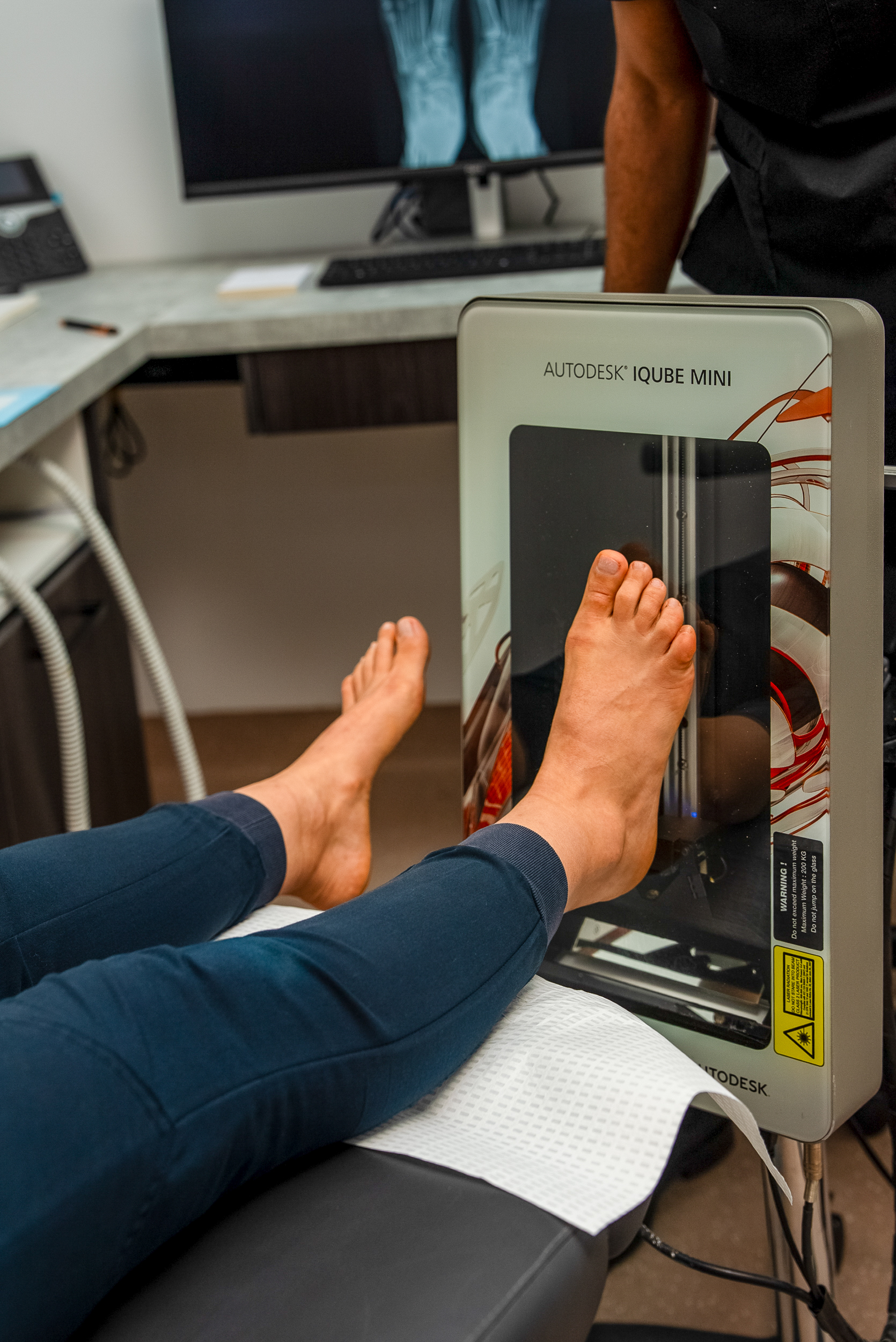
- 3D scanning: A digital scan of the foot is taken and used to fabricate the device via CAD/CAM technology. Increasing accuracy and turnaround time.
The prescription specifies the type of material (rigid, semi-rigid or soft depending on the indication), the amount of posting (wedging to alter foot alignment), any additions (metatarsal pads, heel cups, forefoot modifications), and the shell dimensions to fit your footwear. The orthotic is typically fabricated off-site by a specialist laboratory and fitted at a follow-up appointment 1-2 weeks later.
What Materials Are Used?
Custom orthotics are fabricated from a range of materials depending on the prescription:
- Rigid (polypropylene or carbon fibre): Maximum control of foot motion. Used for significant biomechanical corrections in conditions like severe pronation or tibialis posterior tendon dysfunction. Thinner and more durable, but requires appropriate footwear.
- Semi-rigid (EVA or co-polymer shell): The most commonly prescribed type. Balances control with cushioning. Works in a wider range of footwear.
- Soft (full EVA): Maximum cushioning with minimal motion control. Used primarily for diabetic offloading, elderly patients and conditions where comfort outweighs the need for correction.
How Long Do Custom Orthotics Last?
Most custom orthotics last 2-5 years with regular use. Athletes and people with physically demanding occupations tend to wear them out faster. The shell typically outlasts the top cover, which can be replaced. Annual reviews are recommended to assess for wear and to reassess whether the prescription still matches the current clinical picture - particularly in children who are growing, and in patients whose biomechanical presentation has changed through injury or weight change.
The only way to know whether custom orthotics will actually help your specific presentation is a proper biomechanical assessment. Skip the guesswork - get an answer from a clinical assessment. Book a biomechanical assessment.
Related on our site
Frequently asked questions
Are custom orthotics covered by health insurance?
Most private health funds with extras cover custom orthotics under podiatry, with rebates varying by fund and level of cover. A podiatric prescription and receipt are required for claiming. Custom orthotics may also be funded as low-cost assistive technology under the NDIS.
How long before I feel a difference?
Most patients notice a meaningful difference within 2-4 weeks of wearing orthotics consistently. Full therapeutic benefit is typically felt after 6-8 weeks. An adjustment period of 1-2 weeks is normal as your foot and lower limb adapt to the change in loading pattern.
Do orthotics weaken your feet over time?
This is a common concern but largely unsupported by the evidence. Orthotics support passive load distribution - they don't replace active muscle function. In most clinical protocols, orthotics are prescribed alongside a foot and lower limb strengthening programme, not instead of one. The two approaches complement each other.
Can I use custom orthotics in all my shoes?
Most custom orthotics are fabricated to fit a specific shoe type (sports shoe, dress shoe, work boot). They typically can't transfer between very different shoe styles. Discuss with your podiatrist at the fitting appointment which footwear the orthotic will be used in - this influences the shell dimensions and material choice.
Is there a difference between orthotics from a podiatrist and orthotics from an online retailer?
Yes. Online orthotics - even those marketed as "custom" based on a foam tray impression mailed in - are not the same as a clinically prescribed custom orthotic. A proper custom orthotic prescription is based on a biomechanical assessment, involves clinical reasoning about what corrections are needed, and is fabricated to a clinical specification. Without the assessment, there's no basis for the prescription.