
Foot Pain: Where It Hurts and What It Means
The location of your foot pain is the single most useful diagnostic clue there is. A podiatrist's guide to what heel, arch, ball of foot, toe and ankle pain mean - and how each is actually treated.
TL;DR
Where your foot hurts is one of the most useful diagnostic clues there is - heel, arch, ball of foot, toe and ankle pain each point to different causes. Most foot pain has a mechanical root cause (biomechanics, footwear, load) and responds well to the right conservative treatment. Pain that lingers beyond one to two weeks, worsens with activity, or affects the way you walk needs a proper assessment, not more rest. Bexley Podiatry diagnoses and treats foot pain in-house, including advanced therapies, with urgent appointments available.
Foot pain is not a single thing. The sharp morning stab under your heel, the burning in the ball of your foot after a long day, the ache along the arch after a run - each of those points to a different structure, a different cause, and a different treatment.
The location of your pain is the single most useful piece of information a podiatrist has before an assessment. This guide is built around that: where does it hurt, what is most likely causing it, and what needs to happen next. Approximately one in five Australians experience foot pain at any given time. Most cases are mechanical - driven by how the foot moves, what it's loaded with, or what it's been put in. That means most cases are also treatable with the right approach.
Heel pain
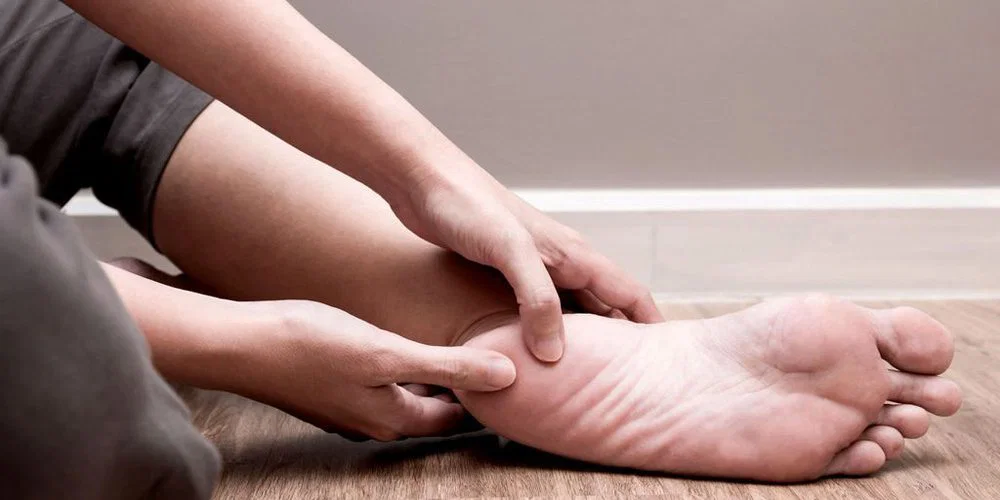
Heel pain is the most common reason people visit a podiatrist. It ranges from the classic morning stab that eases after a few steps, to a dull constant ache that builds through the day. The location within the heel matters - bottom, back, or sides each suggest different structures. The usual causes: plantar fasciitis, fat pad syndrome, Achilles insertional tendinopathy, heel stress fracture, Baxter's nerve entrapment and, in children, Sever's disease.
[Plantar fasciitis](/conditions/plantar-fasciitis) is responsible for the majority of heel pain presentations. The plantar fascia - a thick band of connective tissue running from the heel bone to the ball of the foot - becomes overloaded and inflamed, usually at the point where it attaches to the heel. The signature is pain worst with the first steps after rest, particularly first thing in the morning, that eases once you've been moving for a few minutes.
[Achilles insertional tendinopathy](/conditions/achilles-tendinopathy) sits at the back of the heel where the tendon meets the bone. It produces stiffness and pain with hill walking, stair climbing, and early morning activity. It is a different condition to plantar fasciitis and needs a different treatment approach - which is why diagnosis matters.
The morning test: a useful but imperfect indicator
- Pain worst with first steps, easing quickly: plantar fasciitis is the leading candidate.
- Stiffness at the back of the heel, slow to ease: Achilles insertional tendinopathy.
- Heel pain that does not ease at all with walking: may indicate fat pad damage or, rarely, a stress fracture.
- Children with heel pain during or after sport: Sever's disease (growth plate irritation) is common from ages 8 to 14.
Heel pain that has dragged on for months, or that has already had one round of treatment without improvement, warrants an in-clinic diagnostic ultrasound to see exactly which structure is involved and what state it is in. Generic stretching protocols do not work equally well for all causes.
Arch pain
Pain along the arch of the foot - the curved underside between the heel and the ball - typically comes from structures being placed under more load than they can manage. It is often linked to biomechanical factors: how the foot pronates (rolls inward), the height of the arch, and how well footwear supports the foot during activity. The usual causes: plantar fasciitis presenting mid-arch, tibialis posterior tendinopathy, flatfoot progression, plantar plate tear and tarsal tunnel syndrome.
Arch pain extending from the heel toward the ball is frequently plantar fasciitis presenting more centrally than at the heel attachment. But arch pain that comes with visible collapse of the arch, or that is accompanied by medial ankle swelling, can indicate a problem with the tibialis posterior tendon - the main tendon that supports the arch. Left untreated, tibialis posterior tendinopathy can lead to a progressive flat foot deformity.
[Tarsal tunnel syndrome](/conditions/tarsal-tunnel-syndrome) is a nerve compression behind and beneath the inner ankle that can produce burning or tingling pain radiating into the arch. It is frequently misdiagnosed as plantar fasciitis because the pain location overlaps - but the treatment is completely different.
Flat feet and high arches: when does structure cause pain?
- Many people with flat feet or high arches never develop pain - structure alone is not the problem.
- Pain develops when the foot cannot manage the loads being placed on it, often due to rapid activity changes, footwear, or a change in body weight.
- A biomechanical assessment identifies which structures are overloaded and whether orthotic therapy or a footwear change is needed - not just what the arch height looks like at rest.
Ball of foot pain
Pain in the ball of the foot - the padded area across the base of the toes - is called metatarsalgia as a broad term, but that word describes a symptom, not a diagnosis. The actual cause could be any one of several structures: a nerve, a joint, a tendon, a bone, or the fat pad itself. Getting the right cause identified determines everything about treatment. The usual causes: Morton's neuroma, plantar plate injury, sesamoiditis, metatarsal stress fracture, bursitis and hallux rigidus.
[Morton's neuroma](/conditions/mortons-neuroma) is a thickening of the tissue around the nerve between the toes - most commonly between the third and fourth. It produces a sharp, burning, or electric pain in the ball of the foot, often with a feeling of walking on a pebble. High heels and narrow shoes aggravate it significantly. An in-house ultrasound can confirm the diagnosis and guide targeted injection therapy when conservative approaches haven't resolved it.
Plantar plate injury is a tear in the small ligament that stabilises each toe at its base joint. It often causes pain and swelling under the second toe joint, and in more severe cases the toe begins to drift or cross over. This is commonly missed and mistaken for a general forefoot ache.
Sesamoiditis affects the two small bones (sesamoids) embedded in the tendon under the big toe joint. It is common in runners, dancers, and people who spend long hours on their feet. Pain is localised directly under the big toe and is worse on push-off.
Toe pain
Toe pain is the most varied category - it ranges from structural deformities to nail problems, skin conditions, and joint disease. The big toe alone can be the site of several distinct conditions, each requiring a different intervention. The usual causes: hallux rigidus, bunions, ingrown toenails, hammer toes, gout and toe arthritis.
[Hallux rigidus](/conditions/hallux-rigidus) is stiffness and pain at the big toe joint caused by osteoarthritis. It restricts the toe's ability to bend upward on push-off - a motion that is fundamental to normal walking. The joint may develop a bony bump on top. Early-stage hallux rigidus responds well to orthotic management and footwear modification; advanced cases may need surgical input.
[Ingrown toenails](/conditions/ingrown-toenails) are among the most common reasons people visit a podiatrist and yet are often left far too long. An infected or persistently painful ingrown nail does not self-resolve. Minor surgical correction - a partial nail avulsion under local anaesthetic - takes about 30 minutes and is performed in-clinic at Bexley Podiatry. It is a permanent solution for recurrent cases.
Gout deserves a mention because it is frequently mistaken for a joint injury. A sudden, intensely painful, hot, and swollen big toe joint - particularly overnight - is classic gout and requires urgent medical management, not podiatric manipulation.
Ankle pain
Ankle pain in a podiatry context usually involves tendons, ligaments, or joints rather than the acute sprain that most people associate with the ankle. Chronic ankle problems are significantly underdiagnosed - many patients have lived with instability, tendon pain, or restricted movement for years because an initial sprain was not properly rehabilitated. The usual causes: chronic ankle instability, peroneal tendinopathy, mid-portion Achilles tendinopathy, osteochondral lesions, ankle arthritis and sinus tarsi syndrome.
[Chronic ankle instability](/conditions/chronic-ankle-instability) develops after one or more ankle sprains that were not fully rehabilitated. The ligaments remain stretched, the joint's proprioception (position sense) is compromised, and the ankle repeatedly gives way - often with only minor provocation. Leaving it untreated accelerates cartilage wear.
[Peroneal tendinopathy](/conditions/peroneal-tendon-disorders) affects the tendons running along the outer ankle. It causes lateral ankle pain and swelling that is often confused with a lateral sprain, but the pain is on exertion and the tendons are tender to touch along their course. Differentiating this from ligament injury on examination and ultrasound changes the entire treatment plan.
[Osteochondral lesions](/conditions/osteochondral-lesions) are areas of damaged cartilage and underlying bone, usually resulting from a previous ankle sprain or cumulative trauma. They cause deep ankle pain with activity and may produce clicking or locking. Ultrasound or MRI is needed to characterise the lesion, and management ranges from conservative loading programmes to coordinated surgical referral for larger defects.
How foot pain is treated
Treatment follows diagnosis - not the other way around. This sounds obvious, but it explains why generic advice ("stretch it", "rest it", "ice it") often fails: those interventions are not wrong for every condition, but they are not right for every condition either. A plantar fasciitis loading programme applied to a plantar plate tear, for instance, will make the injury worse.
At Bexley Podiatry, treatment follows a staged approach: accurate diagnosis first, then the least invasive option that is appropriate for the severity and duration of the problem, escalating to advanced therapies in-house when first-line care has not resolved it. The pathway typically works like this:
- Accurate diagnosis - clinical examination and biomechanical assessment, often with in-clinic diagnostic ultrasound to confirm the structure involved.
- Load management and footwear - reducing load on the painful structure through activity modification, footwear review, and temporary offloading.
- Rehabilitation and orthoses - structured loading and strengthening to rebuild tolerance, with prescription orthoses where mechanics are contributing to the overload.
- Advanced therapies - shockwave therapy for chronic tendinopathies and plantar fasciitis, and ultrasound-guided injection therapy where inflammation is stalling progress.
- Minor surgery in-clinic - ingrown toenail surgery and minor podiatric procedures performed by our surgical registrar.
- Coordinated surgical referral - for complex cases requiring a specialist surgeon (bunions, hammer toes, tendon tears, osteochondral lesions), with a detailed referral and ongoing co-management.
When to see a podiatrist urgently
- Foot or ankle pain following a fall, twist, or impact - particularly if weight-bearing is painful.
- A sudden hot, swollen, severely painful joint (possible gout or infection).
- Numbness, tingling, or loss of sensation in the foot.
- Any wound, ulcer, or skin breakdown - especially in people with diabetes.
- Foot pain in a child that is causing limping or refusal to bear weight.
- Rapidly progressive deformity - a toe drifting, a bunion enlarging quickly.
For non-urgent foot pain, the threshold for booking an assessment should still be low. A week or two of persistent pain is enough - waiting months typically means a longer and more involved treatment process. You do not need a GP referral to see a podiatrist; you can book directly.
Still not sure what is causing your foot pain?
An accurate diagnosis is the starting point. Our podiatrists at Bexley Podiatry: Foot & Ankle Clinic, 390 Forest Rd, Bexley NSW 2207, serve Bexley, Rockdale, Kogarah, Hurstville, Carlton, Beverly Hills, Kingsgrove, Arncliffe and the broader St George area, with urgent appointments available. We will pinpoint the cause of your foot pain - then treat it with the least invasive option that will actually work. Call 1300 345 226 or book online to get started.
Related on our site
Reviewed by Dr Ozan Amir, FACPS. This article is general information, not a diagnosis - for advice about your own feet, book an assessment.
Frequently asked questions
Why does my foot hurt when I wake up in the morning?
Morning foot pain that eases after the first few minutes of walking is the hallmark of plantar fasciitis. The plantar fascia tightens overnight and the first steps place sudden load on it. A podiatrist can confirm this with a clinical examination and, where needed, in-clinic diagnostic ultrasound to rule out other causes.
Can foot pain go away on its own?
Some mild foot pain from overuse or new footwear may settle with rest. However, pain that persists beyond one to two weeks, is getting progressively worse, or is affecting how you walk rarely resolves without targeted treatment. The longer it is left, the harder it typically becomes to treat.
What does pain in the ball of the foot mean?
Ball of foot pain (metatarsalgia) has several causes: Morton's neuroma (nerve thickening), plantar plate injury, sesamoiditis, stress fractures, or joint inflammation. The exact cause determines the treatment, which is why a clinical assessment - rather than self-diagnosis - is essential.
What is the fastest way to relieve foot pain?
Short-term relief depends on the cause. Ice and rest help with acute inflammation. Offloading the painful structure with better footwear or a temporary insole reduces load. For persistent pain, the fastest route to lasting relief is an accurate diagnosis from a podiatrist - treating the wrong cause will not resolve it.
Is foot pain related to back or knee pain?
Yes. The way your feet move influences your knees, hips, and lower back. Flat feet, overpronation, or altered gait from chronic foot pain can place excess stress higher up the kinetic chain. Addressing foot mechanics through orthotic therapy or rehabilitation can have a meaningful effect on knee and back pain.
When should I see a podiatrist for foot pain?
See a podiatrist if foot pain has lasted more than one week; if pain is affecting your gait, work, or exercise; if you have numbness, tingling, or swelling; if pain worsens with activity rather than improving; or if you have diabetes and notice any foot change. You do not need a GP referral - you can book directly at Bexley Podiatry.
What is the difference between heel pain and plantar fasciitis?
Plantar fasciitis is the most common cause of heel pain, but not the only one. Heel pain can also come from fat pad syndrome, Achilles insertional tendinopathy, heel stress fractures, or nerve irritation. Getting the right diagnosis matters because treatment differs significantly between causes.
Does Bexley Podiatry offer same-week appointments for foot pain?
Yes. Bexley Podiatry endeavours to see urgent foot and ankle concerns as promptly as possible. Call 1300 345 226 or book online. The clinic is located at 390 Forest Road, Bexley NSW 2207 and is open Monday to Saturday.